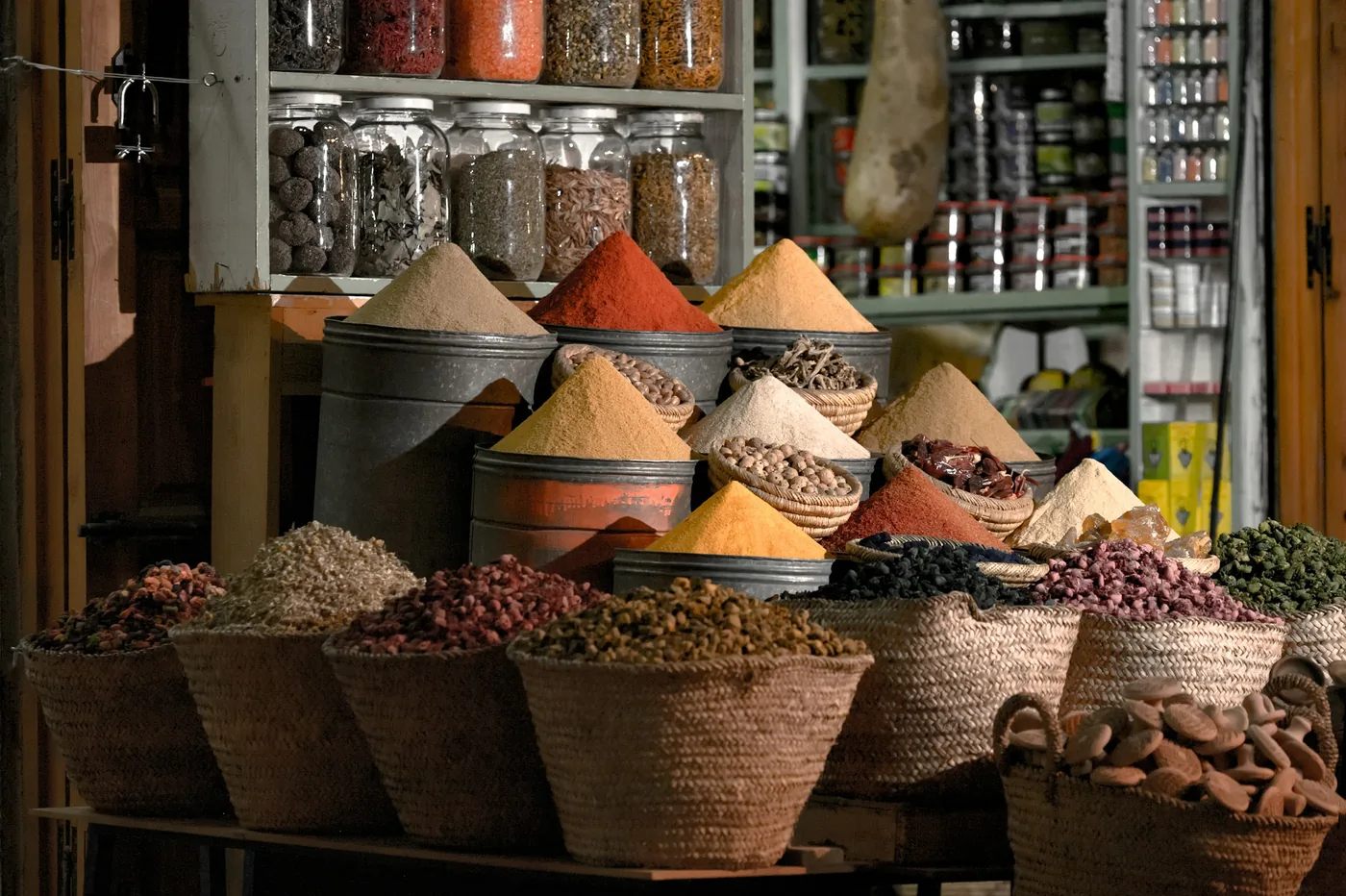
The Marrakech medina is a 1,000-year-old walled city covering 6 km², home to 200,000 permanent residents and the largest traditional souk market in North Africa. It is not a museum or a theme park. Understanding that distinction is the starting point for visiting it well.
What the medina is — and what it isn't
The medina functions as a city: people live, work, buy groceries, attend school, and conduct ordinary life within it. The tourist economy is layered on top of that, not instead of it. The streets serve working craftspeople and neighbourhood families as well as visitors. This matters because it shapes what the experience is — the souks are commercial, noisy, and fully functioning. The historical sites are surrounded by working neighbourhoods, not manicured zones. The medina is worth engaging with on those terms.
The layout of the medina
The medina has no logical grid. It was built incrementally over roughly 900 years, following water channels, property lines, and tribal divisions rather than urban planning principles. Key areas to know:
Jemaa el-Fna and the southern medina
The 2.5-hectare central square (UNESCO Intangible Cultural Heritage since 2001) is the medina's anchor point and the best navigation reference. The area immediately around it contains the highest concentration of tourist restaurants, cafés, and orange juice sellers. Prices here are tourist-adjusted; the square itself is worth experiencing regardless. Evenings, when the food stalls set up and the musicians arrive, are the stronger version of the experience.
The northern souks
The main souk areas fan out north of Jemaa el-Fna along two primary arteries — Rue Semarine and Rue Mouassine. They organise loosely by trade: the Souk Semmarine for textiles, Souk Cherratine for leather goods, Souk Haddadine for blacksmiths, Souk Zrabi for carpets, and the Souk Sebbaghine (dyers' souk) near the Mouassine fountain. The dyers' souk, where wool is hung in brilliant colours to dry, is one of the medina's more photographed corners. It's still a working operation, not a display.
The Mouassine neighbourhood
Northwest of the main souk axis, Mouassine has become the medina's more design-conscious quarter — better independent boutiques, the Mouassine fountain (17th century, one of four built by Sultan Ahmad al-Mansur to provide water to the quarter), and the Mouassine Museum for contemporary Moroccan art. Less frenetic than the souk proper.
The Mellah (Jewish quarter)
The Mellah, established in 1558, is the medina's Jewish quarter — southeast of Jemaa el-Fna, near the royal palace. Its architecture is distinct from the rest of the medina: taller houses with wooden balconies overhanging the street, a product of the specific social organisation of the quarter. The Jewish community is largely absent now (most emigrated in the mid-20th century) but the cemetery, the synagogue of Lazama, and the distinctive street pattern remain.
How to navigate
Download Google Maps offline before you arrive. The medina is well-covered and the offline version works without data once downloaded. Key landmarks that are visible from a distance: the Koutoubia minaret (70 metres, southwest medina, visible from most of the old city), the ramparts (circuit of 19 km, useful as outer boundaries), and Jemaa el-Fna itself. Most disorientation resolves by walking in any direction until you hit a wall or a major artery.
Avoid accepting help from anyone who approaches you to "show you the way" — this is a well-established hustle that ends at a carpet shop or cousin's restaurant. Google Maps is more reliable and doesn't have a financial interest in your destination.
The souks: what to know before you go in
Souk prices are negotiated. The starting ask on most items is 3–5× the realistic sale price. Approach negotiation as a commercial transaction rather than a cultural experience you're obliged to complete — you don't have to buy anything. A counter-offer at 30–40% of the ask is a normal opening. Walking away often results in a better offer. The vendors are professional negotiators who do this every day; match the energy rather than trying to out-manoeuvre it.
What to buy well: leather goods (babouches, bags), copper and brass objects, handmade ceramics, argan oil (buy from cooperatives, not souk stalls), and Moroccan textiles. What to be more cautious about: "antiques" (most are reproductions), "pure" argan oil at suspiciously low prices, and anything where the seller's opening gambit involves a fake discount or limited-time story.
The medina at different times of day
Before 9am: the best version of the medina. Stalls setting up, bakers pulling bread from communal ovens, the morning light in the alleys. Almost no tourist traffic. This is worth the early start. Midday in July–August: genuinely difficult. 38–42°C heat concentrated in narrow alleys. Afternoons in all seasons: peak tourist and commercial activity, most crowded. After 8pm: Jemaa el-Fna at its best, the food stalls lit up, the square alive. The medina streets quiet down by 10pm.
The main historical sites
The Koutoubia Mosque (12th century, 70-metre minaret, non-Muslims cannot enter but the exterior and gardens are open), the Bahia Palace (19th-century vizier's palace, 8,000 m² of rooms and gardens, entry 70 MAD), the Saadian Tombs (16th-century royal necropolis, rediscovered only in 1917, entry 70 MAD), the Ben Youssef Madrasa (14th-century Quranic school, one of the largest in North Africa, entry 70 MAD), and the Marrakech Museum in the Dar Menebhi Palace. Most sites are walkable from each other within the medina.
Want a day-by-day itinerary that routes you logically through the medina and beyond? Kech Edit builds one free in under 60 seconds →
Frequently asked questions
Is the Marrakech medina safe to visit?
Yes. The medina is densely populated, busy, and not dangerous. Petty hustling (fake guides, persistent vendors) is the main nuisance. Stick to populated areas after dark and the experience is straightforward.
How big is the Marrakech medina?
Approximately 6 km² inside 19 km of ramparts. Home to roughly 200,000 permanent residents — a functioning city, not a preserved quarter.
What is Jemaa el-Fna?
The medina's central square (2.5 hectares), UNESCO Intangible Cultural Heritage since 2001. Orange juice, snake charmers and henna artists by day; food stalls, musicians and storytellers in the evening. The medina's social heart.
What are the main souks?
They fan out north of Jemaa el-Fna, organised loosely by trade: textiles (Semmarine), leather (Cherratine), blacksmiths (Haddadine), carpets (Zrabi), and the dyers' souk (Sebbaghine) near the Mouassine fountain.
Should I hire a guide for the medina?
For a first visit, yes — an official guide (book through your riad or the tourist office, not from street approaches) provides context and navigation that takes years to accumulate independently. Half-day rates: 300–500 MAD.